Free shipping in DE
  30 day returns
  Secure payment
  2 years warranty




The beginnings: Manual treadmills as simple fitness equipment
The earliest precursors of treadmill-like devices date back several centuries – originally, they were not used for fitness, but as work tools, for example for grinding grain or pumping water using human or animal power. Towards the end of the 19th and the beginning of the 20th century, however, the idea of using treadmills for physical training began to develop, albeit in a very rudimentary form.
These early manual treadmillsMostly made of simple wooden frames and leather straps, these machines relied entirely on the user's muscle power to set the belt in motion. Without motors or electronic components, they functioned as simple cardio machines: the faster or harder one walked or ran, the more resistance the belt generated through natural friction.
The design limitations of these models were clear:
no adjustable speed,
no angle of inclination,
There is hardly any possibility of targeting specific training goals.
The pace was determined solely by one's own stride, which made consistent exertion difficult. Nevertheless, these simple treadmills laid the foundation for understanding continuous movement and cardiovascular exercise. They conveyed for the first time the idea that a stationary device could simulate running outdoors – thus sparking early interest in home fitness solutions, long before modern technology was available.
The step towards mechanization: Motorized treadmills conquer the home
The middle of the 20th century marked a turning point with the introduction motorized treadmills, which fundamentally changed the concept of home training. Unlike their manual predecessors, these devices had electric motors that powered the treadmill propulsion. Users could now set a fixed speed without having to expend additional energy to keep the belt itself moving.
This innovation solved a key problem with manual treadmills: the Inconsistency of paceWith a motorized system, one could fully concentrate on running style, stride length and training performance, while the belt ran reliably at the selected speed.
In addition, there was the introduction of a adjustable incline angleThe ability to simulate hill runs significantly increased the variety of training – the training became more intense, additional muscle groups were activated, and different goals such as weight reduction, endurance increase or performance improvement could be pursued more effectively.
During this phase the first ones also appeared pre-made training programs on, which automatically varied speed and inclination. Even though they were quite simple compared to today's standards, they implemented the principle of structured training one – the user could follow a predefined interval or route profile without having to plan everything themselves.
At the same time, awareness grew regarding the importance of regular exercise for health. With increasing urbanization and limited access to safe outdoor spaces, home workouts gained in popularity. Motorized treadmills became the symbol of the modern home gym – paving the way for the next stage of development: digital integration.
The digital revolution: Integration of basic electronics
At the end of the 20th and beginning of the 21st century, the digital revolution in the treadmill design. The most visible change was the introduction digital displays – mostly LCD screens – that displayed real-time metrics such as speed, distance, time and calorie consumption.
This turned a rough estimate into a data-driven training controlUsers could track their progress, define training goals, and motivate themselves through measurable results.
In addition, the Heart rate measurement as a standard feature, for example via hand sensors on the handles. Although these systems were not yet as precise as modern chest straps or optical sensors, they enabled, for the first time, basic monitoring of cardiovascular stress.
Other typical characteristics of this phase:
digital keys or touchpads for Speed and gradient control,
stored on the device Training programs by target category (Fat burning, endurance, cardiovascular training).
This changed the treadmill From a passive device to a more interactive training partner. The digital phase paved the way for the next step: the smart treadmill, embedded in the smart home ecosystem.
The smart transformation: Connectivity and adaptive functions
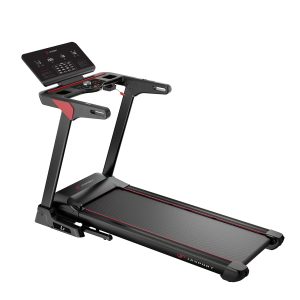
today Smart treadmills They represent the technological pinnacle of treadmill development for the home gym. The focus here is on the NetworkingA smart home treadmill uses Bluetooth, Wi-Fi and app integration to create a seamless digital fitness experience.
Typical functions:
connection with Smartphone, tablet or smartwatch,
automatic synchronization of training data,
Long-term tracking of progress,
Personalized recommendations based on past workouts.
A key feature of modern smart treadmills is their ability to adapt. adapting to the user in real timeBuilt-in sensors detect:
Step frequency (cadence),
Footrest,
Heart rate (via chest strap or optical sensors),
and automatically adjust speed and incline to the fitness level or defined training goal. This keeps workouts challenging yet safe – regardless of whether the goal is endurance, calorie burning, or rehabilitation.
Virtual coaching is another milestone:
Many smart treadmills offer guided runs with trainers via screen or app, including:
Technical instructions,
Speed limits,
motivating feedback in real time.
The integration into Smart Home further enhances the benefits:
Voice control via Alexa, Google Assistant & Co. (start/stop, speed, incline),
Integration with smart scales, sleep trackers or nutrition apps,
Comprehensive health overviews across multiple devices.
That's it Treadmill for the Smart Home no longer just a training device, but a core component of a networked, data-driven lifestyle.
A look into the future: Trends for the next generation of treadmills
As technology continues to advance, the treadmill will also continue to evolve. Key future trends:
1. Artificial intelligence (AI)
AI-supported systems will be:
Evaluate training data
Suggest individual training plans
Adjust workload in real time based on fatigue or progress,
Actively recommend recovery phases.
2. Biomechanical feedback
Advanced sensor technology could:
Analyze running style
Recognizing imbalances,
Provide information on stride length, foot placement, or hip stability,
Prevent overload injuries.
3. AR & VR Integration
Augmented and virtual reality could:
Simulate virtual landscapes and routes,
Dynamically link gradient and speed to digital environments,
To make indoor running significantly more immersive and playful.
4. Sustainability
Future treadmills will increasingly focus on:
energy-efficient motors,
recyclable materials,
Possibly even implement energy recovery.
In addition, this will Treadmill in the Smart Home Intended primarily as a family tool:
multiple user profiles,
cloud-based storage,
Data exchange with doctors or coaches for health-oriented training management.
More than just mechanics: What treadmill development reveals about modern fitness needs
The evolution from manual to smart treadmills is more than just a technological story – it also reflects changing values and priorities regarding fitness.
Previously, the main goal was: enabling movementRegardless of weather or location. Today, users expect significantly more:
Personalization,
Real-time feedback,
seamless integration into their digital environment.
The Smart treadmill for the smart home It addresses precisely these needs – it combines cutting-edge technology with user-centered design.
At the same time, this development shows how important Convenience and availability In today's hectic world, training solutions that integrate seamlessly are in demand. Smart treadmills with adaptive functions and minimal setup offer an ideal answer.
Ultimately, this development illustrates a simple truth:
Fitness technology is constantly evolving in response to human needs.
From simple, manual treadmill Every step towards an intelligent, networked system was geared towards movement:
more accessible
more effective
motivating
to do. And in the future, the treadmill will continue to play a central role in the smart home – not only as a device, but as a symbol of how technology supports our path to health and well-being.