Free shipping in DE
  30 day returns
  Secure payment
  2 years warranty
Treadmills in the gym: Useful addition or unnecessary trend?
The world of fitness has changed significantly in recent years. While outdoor training once dominated, training in the gym is now experiencing a real boom. One of the most commonly used pieces of equipment is the treadmill. But how useful are these machines really? In this article, we'll explore the advantages and disadvantages of treadmills in the gym and examine their benefits for different target groups.
The versatility of treadmills
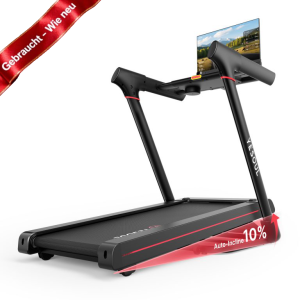
Treadmills have become an indispensable part of modern gyms. They offer a variety of training options suitable for both beginners and experienced athletes. You can jog or run at different speeds, increase the intensity of your workout by adjusting the incline, and many machines have integrated programs that add variety to your workout.
Benefits of treadmills
- Weather-independent training: One of the biggest advantages of treadmills is their weather independence. Whether it's rain, snow, or heat, you can train anytime in a controlled environment.
- Injury prevention: Treadmills offer a softer running surface compared to hard asphalt or uneven paths. This can help prevent joint and muscle injuries.
- Accuracy of training data: Many treadmills are equipped with sensors that provide precise data on time, distance, speed, and heart rate. This data is important for monitoring your workout progress.
- Interactive training options: Many modern treadmills also offer the option of completing virtual races or synchronization with apps that document progress.
Disadvantages of treadmills
- Monotony: A common argument against treadmill training is monotony. Running for long periods in one place can become boring and reduce motivation.
- Technology dependence: In the event of a technical defect, the device will no longer function. This can significantly impair the training effect if the user relies on it.
- Lack of natural resistance: Running outdoors often involves running against wind and on changing surfaces. This can provide additional resistance that a treadmill lacks.
Target groups for treadmill training
Treadmills are particularly valuable for certain target groups. Let's take a look at some of them:
1. Beginner
Beginners can benefit from the stability and controlled environment that treadmills provide. The ability to adjust the pace and incline allows everyone to work at their own pace without overexerting themselves. This helps them learn the basics of running before venturing outdoors.
2. Rehabilitation
Treadmills are an ideal choice for people recovering from injuries. Physical therapists often use them for rehabilitation because the adjustable speed and incline allow for precise training.
3. Competitive runners
Competitive runners use treadmills for targeted race preparation. By incorporating the treadmill as a supplemental workout, they can improve their endurance and speed without the stress of environmental factors.
Tips for effective training on the treadmill
To get the most out of treadmill training, consider the following tips:
- Warm-up and cool-down: Always start with a warm-up and cool-down to avoid injuries and optimally prepare your body for the strain.
- Correct running technique: Maintain an upright posture and slightly elevated foot position to relieve pressure on your joints.
- Variation in training: Vary between interval training and steady pace to increase performance and avoid boredom.
Conclusion
While we won't use the word "conclusion," it's important to emphasize that treadmills have both advantages and disadvantages. Their suitability depends largely on the individual needs and goals of the user. While some may find them a useful addition to their workouts, others may consider them superfluous. Regardless of opinion, treadmills remain a popular choice in the world of fitness.