Free shipping in DE
  30 day returns
  Secure payment
  2 years warranty
Difference between cross trainer and stepper: Which is the better fitness equipment?
In the world of fitness, there are numerous pieces of equipment designed to tone the body and achieve overall health goals. Two of the most popular machines are the elliptical trainer and the stepper. Although they are often placed side by side in gyms, there are significant differences between the two that affect how they function, the amount of calories burned, and the muscles they target. In this article, we'll explore the differences between elliptical trainers and steppers in detail to help you determine which machine is best suited for your fitness goals.
How it works: Cross trainer vs. stepper
The cross trainer, also known as an elliptical trainer, enables an elliptical movement, which is a combination of running and cycling. This type of exercise is gentle on the joints, as it reduces stress on the knees and joints. Most cross trainers are equipped with movable handlebars, which also support upper body training, meaning both the legs and arms are used during the workout.
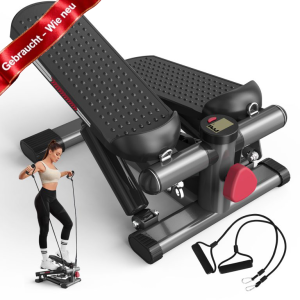
In contrast, the stepper, as the name suggests, works by simulating the movement of climbing stairs. The stepper focuses on the movement of the leg muscles and primarily targets the thighs, glutes, and calves. While training on a stepper has less impact on the upper body, the steep movement places a more intense strain on the lower body.
Calorie consumption: What burns more calories?
A common concern among fitness enthusiasts is calorie consumption. It's often assumed that more intense training leads to higher calorie consumption. On a cross trainer, users can burn approximately 400 to 600 calories per hour at moderate intensity—this depends largely on body composition and workout intensity. The ability to adjust resistance levels allows users to vary the intensity and thus influence calorie consumption.
With a stepper, calorie consumption is typically around 350 to 500 calories per hour, depending on the intensity of the workout. This focuses more on the leg muscles, while the upper body receives less stress. Calorie consumption can also be increased by adding weight, such as hand weights, or increasing the training speed.
Muscles used: What is being trained?
The advantage of a cross trainer is that it targets a wide variety of muscle groups. Training on a cross trainer activates both the leg muscles—including the quadriceps, hamstrings, and calves—and the upper body muscles, including the shoulders and back muscles. The balance between upper and lower body training makes the cross trainer an excellent total-body workout.
In contrast, the stepper primarily targets the leg muscles. In addition to the thighs and calves, the glutes are also intensively targeted. If the primary goal is to build lower body muscle, the stepper might be a better choice—especially for people focused on improving leg fitness and strength.
Gentle on the joints: Which device is better for the joints?
A significant advantage of the cross trainer is its joint-friendly design. The elliptical motion significantly reduces stress on the joints, making it particularly suitable for people with joint problems or those who are overweight. A gentler workout reduces the risk of injury and strain.
User experience: comfort and ease of use
In terms of user-friendliness, cross trainers often offer a variety of features and settings to customize your workout. Many models are equipped with programs aimed at specific fitness goals, allowing users to adjust the intensity, duration, and type of workout. This adaptability makes the training attractive for both beginners and advanced users.
Most steppers, by comparison, are rather simple, with a few controls that typically control the resistance setting and duration. While this may be beneficial for some users, the stepper may be less suitable for those seeking variety and adaptability in their workout.
Value for money: What does what cost?
When purchasing a piece of fitness equipment, value for money is crucial. Ellipticals are generally more expensive than steppers, reflecting their multifunctional capabilities and higher calorie burn. A high-quality elliptical can cost anywhere from €400 to over €2000, while simpler steppers are available for as little as €100. Therefore, price-sensitive users may prefer the stepper, while fitness enthusiasts may be willing to invest more in an elliptical.
Conclusion: Which device is right for you?
Before deciding whether the elliptical or stepper is better suited to your fitness goals, consider your personal preferences and physical condition. The elliptical offers a low-impact full-body workout, while the stepper allows for more intense lower-body workouts. Ultimately, the choice of equipment depends on your individual fitness goals, injury history, and comfort level.