Free shipping in DE
  30 day returns
  Secure payment
  2 years warranty



The connection between rowing machine training and spinal well-being
The rowing machine Rowing is an indoor fitness device that replicates the movement of rowing on water and has become established because it enables a comprehensive workout that challenges both the cardiovascular system and the muscles. For spinal health, it is particularly relevant that rowing offers a combination of whole-body activation and joint-friendly, low-impact mechanics. Unlike high-impact activities that generate direct pressure or shear forces on the spine, the rowing stroke distributes the work between the legs, core, and upper body. This creates the opportunity to strengthen the stabilizing muscles around the spine – provided the movement is executed precisely.
The focus is on the biomechanical sequence of the rowing stroke: Catch (front position), Drive, Finish (final pull) and Recovery (return)In the catch position, the body is leaning forward from the hips, the knees are bent, and the shins are almost vertical – here, the core must work isometrically to maintain a neutral spine. The drive starts with a powerful leg push and transfers the power through the hips and torso to the grip. This activates the posterior chain – especially the hamstrings. Back extensor (Erector spinae), large gluteal muscle (gluteus maximus) and Hamstrings —which act as natural supports for the lumbar spine. In the final step, the upper body leans back slightly, the arms pull the handle towards the chest; this requires coordinated activation of Rhomboids and latissimusto stabilize the thoracic spine. During recovery, the sequence is performed in a controlled reverse to return cleanly to the catch position.
The crucial factor is how well these phases are managed. synchronized With correct technique, the repeated movement improves blood flow to the spinal muscles, increases their endurance, and strengthens neuromuscular patterns that prevent misalignments. Even small deviations—such as hyperextension of the lower back at the finish or a rounded back in the catch position—can negatively shift the load and cause microtrauma that can develop into back pain over time. This makes it clear: the machine itself is neutral—the effect on the spine arises from technique, body awareness, and load control. Anyone who wants to protect their spine while rowing starts with understanding this interplay.
Common stress points on the spine during rowing
Although that rowing machine Although considered easy on the joints, rowing can become a source of spinal stress if the movement patterns are incorrect. Three typical stress points occur particularly frequently – each in specific phases of the rowing stroke.
(1) Hyperextension of the lumbar spine in the finish
Many athletes overextend their backs at the end of the stroke to achieve a "fuller" power stroke. This excessive arching of the lower back puts the lumbar spine into hyperextension: anterior ligaments are overstretched, and posterior facet joints are compressed more. Over time, this can lead to ligament irritation, facet joint problems, or increased stress on the intervertebral discs – often felt as a dull, persistent pain in the lower back. The insidious thing is that for many, it feels like "putting in more effort," not like a mistake.
(2)Rounded back and forward shoulders in the catch position
Lying forward often results in rounded shoulders and increased curvature of the thoracic spine, usually due to shortened pectoral muscles or weak upper back stabilizers. In this position, the pulling force is more readily transferred to the spinal structures, increasing pressure on the intervertebral discs. Over time, this can put more strain on the discs, reduce the intervertebral space, and irritate nerve structures – leading to back pain or radiating symptoms.
(3)Dominant hip flexors instead of glutes/hamstrings in the drive
If the glutes and hamstrings don't effectively "lead," the hip flexors (e.g., iliopsoas) often take over. This pulls the pelvis into an anterior tilt and increases the lumbar lordosis, placing more strain on the lumbar spine. The lower back then has to compensate for this, fatigues more quickly, and can react with tension, cramps, or chronic overuse injuries. Beginners are particularly vulnerable when speed is prioritized over control.
These points show that back pain during rowing rarely arises "from the rowing machine“but rather through undetected technical and activation deficiencies that disrupt the otherwise balanced load distribution.
Expert guidelines for spinal protection on the rowing machine
Experts emphasize four pillars: Orientation, Muscle activation, load control and Regeneration.
(1) Basic principles of attitude and orientation
Neutral spine Throughout all phases: maintain natural curves, do not overdo it.
Wrestling: Chest "lifted", shoulder blades set, no collapse in the upper back.
Core voltage: Activate the deep abdominal muscles (va transversus abdominis) without holding your breath.
Pelvic position: stable and controlled, no extreme arching of the back and no curling up.
Head/ Neck: in line with the spine, without pushing the chin forward.
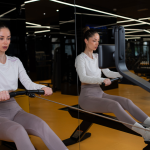
Mirrors or video feedback help to make small deviations visible, which often feel "normal".
(2) Progressive muscle activation: letting the right muscles lead
A brief mental "pre-tension" can help before the drive:
Activate Core (Gently stretch the abdominal wall),
target buttocks (slight glute tension),
"Prepare" hamstrings (Actively perceive the back of the leg).
In Drive: press over the heelsKeep your arms relaxed until your legs are almost straight. The sequence remains the same: Legs → Hips/Torture → ArmsThis allows large muscle groups to work more efficiently, while the back has to compensate less.
(3) Adjust intensity and duration appropriately
For those with back problems or beginners:
low resistance
10-15 minutes, 2–3 times per week start.
Then increase gradually:
Resistance +5–10% every 1–2 weeks,
Duration in 5-minute increments increase – only if no pain occur.
Interval training is possible, but be careful: 1–2 times per week, otherwise longer, more consistent sessions are preferable for clean technique and endurance of the supporting muscles. Sharp, shooting pain This is always a signal: reduce intensity or pause.
(4) Actively integrate regeneration
After rowing:
stretching the hip flexors, thoracic spine and lumbar spine surrounding structures,
“Relief” movements such as Cat-Cow and Child's Pose, to promote joint mobility and tissue flow.
Dazu 1-2 days of rest per week, so that the supporting muscles can adapt and no overload occurs.
Incorporate rowing into a back-friendly overall routine.
Rowing works best as part of a balanced program. Heat, kraft, Mobility and Technical maintenance.
Before the session (5-10 minutes):
Dynamic mobilization exercises such as leg swings, arm circles, and gentle torso rotations – controlled, not frantic – increase tissue temperature and prepare for stabilization.
Supplementary strength training (2–3 times per week):
Plank (20–30 s, later up to 60 s) for core endurance,
Bird dog for lumbopelvic coordination,
Glute bridge for glutes/hamstrings (less hip flexor dominance).
Nice 2–3 sets of 8–12 repetitions are often sufficient to strengthen the basis for back-friendly rowing.
Mobility (2-3 times per week):
Stretch your hip flexors (e.g., half-kneeling lunge),
Loosen the front of the thighs/fascia (foam rolling),
Open the chest muscles (door frame stretch) so that the catch position does not tip into a rounded position.
This creates a synergy effect: rowing builds endurance and muscle stamina, while complementary work corrects bottlenecks and prevents technique from "falling apart" under fatigue.
Sustainable spinal support through mindful rowing
Long-term spinal health is not only achieved through "correct technique", but through mindful self-control: Perceiving body signals, correcting them in real time and flexibly adjusting the load.
Breathing as a pacemaker: Exhale during the drive (power phase), inhale during the recovery (relief phase).
Distinguish between activation and fault voltage: If the lower back feels "hard and tight" instead of "stable", this is often an indication of hyperextension or compensation.
Short and regular rather than rare and extreme: More frequent 15-20 minute sessions are usually more beneficial for the supporting muscles than sporadic maximum loads.
Patience with adjustment: Efficient movement patterns and neural automation take time – often several weeks of regular practice.
Ultimately, "spinal health" is the key. rowing machine“Not a single goal, but an ongoing practice: maintaining proper alignment, activating muscles effectively, managing exertion, and taking regeneration seriously. In this way, the rowing machine becomes a partner for a strong, resilient back – stroke by stroke.”