Free shipping in DE
  30 day returns
  Secure payment
  2 years warranty
Rowing machine with or without water: What's the best choice for you?
Rowing is one of the most effective training methods for improving endurance, strength, and coordination. More and more people are choosing to purchase a rowing machine for their home workouts. But when purchasing, many face the crucial question: Should I choose a rowing machine with water resistance or one with air resistance? In this article, we'll explore the advantages and disadvantages of both types and help you make the right decision.
The advantages of rowing machines with water resistance
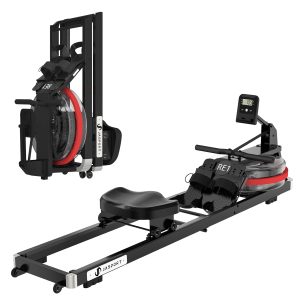
Rowing machines with water resistance offer a unique, realistic rowing experience. The water in the tank creates a smooth, flowing motion when rowing, very similar to real rowing on water. This natural resistance has several advantages:
- Realistic training: The feeling and resistance of rowing with water are very authentic, which can further increase motivation.
- Adjustable resistance: The resistance can be determined by the intensity of your rowing movements. The faster and more powerfully you row, the more resistance you create.
- Aesthetics: Many users appreciate the attractive design of the water rowing machines, often with a wooden frame and a viewing window for the water tank.
The disadvantages of rowing machines with water resistance
Although water resistance offers many advantages, there are also some aspects to consider:
- Maintenance effort: The water tank must be cleaned and refilled regularly, which means additional effort.
- Larger size: Water rowing machines are often heavier and take up more space, which can be problematic in smaller apartments.
The advantages of rowing machines with air resistance
Unlike water rowing machines, air resistance machines use a fan to generate resistance. These machines also have their own specific advantages:
- Easy to use: The devices are generally lighter and easier to store because they require less space.
- Low maintenance: There is no fluid to maintain or clean, making it easy to care for.
- Versatility: Air rowing machines are often equipped with different resistance settings that allow you to individually adjust the difficulty of your workout.
The disadvantages of rowing machines with air resistance
Despite their advantages, rowing machines with air resistance also have some disadvantages:
- Noise development: Propeller-driven devices are often louder than their water-powered counterparts, which can be disruptive in a quiet environment.
- Less realistic rowing feeling: The resistance is less natural and may be perceived as less appealing.
What are the deciding factors when making a selection?
The decision between a rowing machine with water or air resistance depends largely on your personal training goals and preferences. Here are some critical points to consider:
- Space: Do you have enough space for a larger water rowing machine or would a more compact air machine make more sense?
- Volume: How important is a quiet training environment to you?
- Training goals: Do you value a realistic training experience, or is functionality more important to you?
Recommendations for beginners and advanced users
For beginners, it's best to choose a machine that's easy to use and maintain. An air rowing machine may be a better choice. More advanced athletes, however, may appreciate the benefits and realistic feel of a water rowing machine. It might even be worth trying both types to see which resistance suits you better.
Other aspects that are important when making a purchase decision
Here are some additional considerations to guide your decision:
- Price-performance ratio: Pay attention to the quality and features of the rowing machine in relation to the price.
- Warranty and Service: Make sure the manufacturer offers good warranty and customer support.
- Recommendations and test reports: Read reviews and testimonials from other users to learn more about the advantages and disadvantages of each model.
Ultimately, your decision will come down to personal preference. Whether water or air, both types of rowing machines have their advantages, which should be balanced with your training goals. Understanding the differences will help you make the best choice for your individual training needs.