Free shipping in DE
  30 day returns
  Secure payment
  2 years warranty
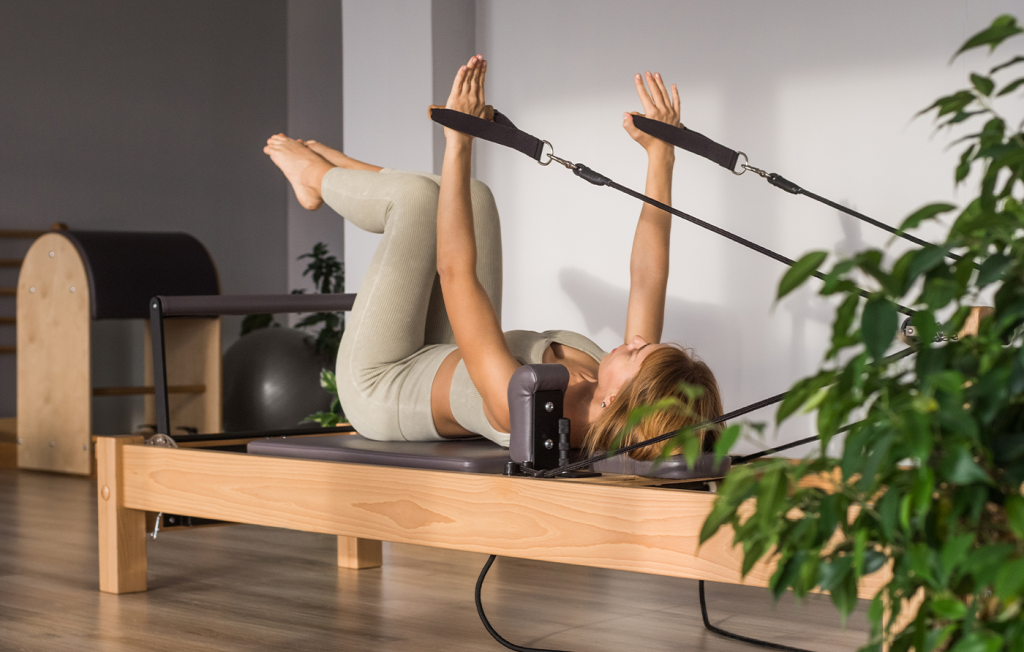
Unleashing the body's potential: Pilates as a path to balanced vitality
On the path to greater physical well-being, flexibility and strength are often viewed as separate goals – trained in different routines and with different mindsets. In reality, however, they are two sides of the same coin. Only their interplay enables fluid movements, stable posture, and lasting vitality.
Modern life, with its long hours at the desk, repetitive movements, and predominantly sedentary activities, has significantly disrupted this natural balance. Tense hips and shoulders, weakened deep muscles, or a vague feeling of lacking body control are typical consequences. This is precisely where Pilates comes in.
Based on the principles of control, precision, and conscious breathing, Pilates offers a holistic approach to building flexibility and strength simultaneously – entirely without the need for external equipment. It is far more than a training program: it is a method for consciously reorganizing movement patterns and promotes effective mind-body synergy.
The focus is on Pilates for flexibility – an approach that understands mobility not as a static property, but as a dynamic quality inextricably linked to strength. Through controlled, mindful movements, tensions are released, the range of motion is expanded, and at the same time, the muscular foundation is created that makes true, functional mobility possible in the first place.
The Science of Mobility: How Pilates Sustainably Promotes Flexibility
To understand how Pilates improves flexibility, it's worth looking at the difference between passive stretching and active movement. While passive stretching involves external forces pulling a muscle length, Pilates focuses on active range of motion – every movement is consciously initiated and controlled by the body itself.
The muscles lengthen under gentle activation. This specifically reduces tension, particularly in the hips, shoulder girdle, and spine. At the same time, proprioception, i.e., the perception of the body in space, improves.
Through the combination of length and control, trainees learn to recognize and release habitual tension patterns. This results in improved muscle elasticity, increased joint mobility, and greater ease in everyday movements such as bending, twisting, and stretching.
A key success factor of Pilates for flexibility The key is conscious breathing. Inhaling expands the rib cage, creating space in the upper body. Exhaling supports a deeper stretch and activates the deep abdominal muscles, which ensure stable spinal alignment. This results in gains in flexibility that are functionally useful and structurally sound. Because the exercises are performed in a controlled manner and without momentum, the nervous system also learns to accept new ranges of motion as safe – this reduces the risk of injury and makes flexibility a stable part of everyday life.
Building functional strength: The unique training logic of Pilates
Strength training in Pilates is not about maximum muscle mass or explosive peak performance. The focus is on functional strength – the kind of stability and muscle control that improves posture, protects joints, and makes movement efficient.
The deep stabilizing muscles are specifically targeted: the transversus abdominis muscle, which encircles the torso like a corset, the pelvic floor as the foundation of core stability, and the small, segmental muscles along the spine. These muscle groups are often neglected in traditional strength training.
Pilates trains the muscles through controlled resistance – usually using body weight or subtle positional changes instead of additional weights. This requires concentration and precision, ensuring that each movement activates the correct muscles in the correct sequence.
For example, during leg or glute exercises, the deep abdominal muscles remain active to prevent an arched back. This allows the body to learn to build strength without compromising structural balance. A stable core enables the arms and legs to safely utilize greater ranges of motion. Furthermore, the slow, deliberate execution improves neuromuscular coordination – strength is not applied in a restrictive manner, but rather fluidly and with control.
The synergy effect: Why flexibility and strength are inseparable in Pilates
Isolated flexibility training can lead to instability, while isolated strength training can lead to stiffness. Pilates systematically combines both qualities.
One example is hip mobility: Greater flexibility of the hip flexors and rotators allows for greater leg movements. At the same time, strong hip stabilizers ensure controlled execution and protect the lumbar spine and sacroiliac joint.
This interaction is also evident in the shoulder area. A flexible thoracic spine improves arm movement, while stable scapular muscles ensure stability and integration.
This mutual support is enhanced by the conscious body awareness in Pilates. Every movement is performed with a focus on correct alignment, controlled breathing, and targeted muscle activation. Flexibility without strength remains incomplete, and strength without flexibility is limiting. The goal is a body that is both stable and supple.
Pilates as a lifelong practice for lasting vitality
Pilates is not a short-term training program, but a long-term investment in movement quality. The method can be adapted to any fitness level, age, and different phases of life.
Whether after prolonged inactivity, in advancing age or for performance optimization – the basic principles remain the same: control, precision and conscious breathing.
Regular training results in lasting mobility, improved posture, reduced joint stress, and more energy in everyday life. Over time, a balanced vitality develops: the body moves fluidly, reacts resiliently to stress, and feels both powerful and flexible.
The positive effects are evident not only in the studio, but in everyday life – when standing upright, lifting a child, or breathing freely and deeply. Pilates is not about achieving a goal, but about building a lasting relationship with your own body. A relationship in which flexibility and strength are not opposites, but harmonious partners on the path to healthy, functional movement.