Free shipping in DE
  30 day returns
  Secure payment
  2 years warranty

Rethinking the core concept
In today's fitness culture, the term "core" is often reduced to the visible six-pack. This superficial view focuses on aesthetics and ignores the core's actual function as the foundation for stability and movement.
This is precisely where the concept of Pilates for Core Instead of just training visible muscles, Pilates for Core takes a holistic approach, understanding stability, breathing and power transmission as an integrated system.
This makes it clear that core definition does not merely describe a visual contour, but is the result of internal stability. Anyone who understands core definition through Pilates for Core Developed, it not only builds visible muscle tension, but also a resilient foundation for everyday life and sports. Functional strength arises as a natural extension of an intelligently trained core.
The anatomy behind true core definition
To understand how Pilates for Core With training redefined, it's worth taking a look at the deep muscles. The core consists not only of the rectus abdominis, but of a complex network: transversus abdominis, multifidus, pelvic floor, internal and external oblique abdominal muscles, and deep back extensors.
In Pilates for Core training, these muscles are not isolated, but activated systematically and in a coordinated manner. In particular, the conscious activation of the transversus abdominis forms the basis for stable movement patterns.
This approach creates core definition from within. Unlike pure six-pack training, the spine is protected while power is transferred efficiently. Pilates for Core This not only promotes muscle strength but also neuronal control – a crucial factor for functional stability.
Training principles of Pilates for Core
Pilates for Core training is based on clear principles that precisely control movement quality and muscle activation.
Centering means initiating every movement from the powerhouse – the area between the lower abdomen, lumbar spine, and hips. Precision ensures that precisely the muscles necessary for developing core definition are activated. Flow connects individual exercises into fluid movement sequences, thereby maintaining constant core activation.
Unlike momentum-based repetitions, Pilates for Core Emphasis is placed on controlled, conscious muscle work. This creates a deep, functional core definition that is not only visible but also noticeably stable.
Holistic movement patterns in Pilates for Core Training
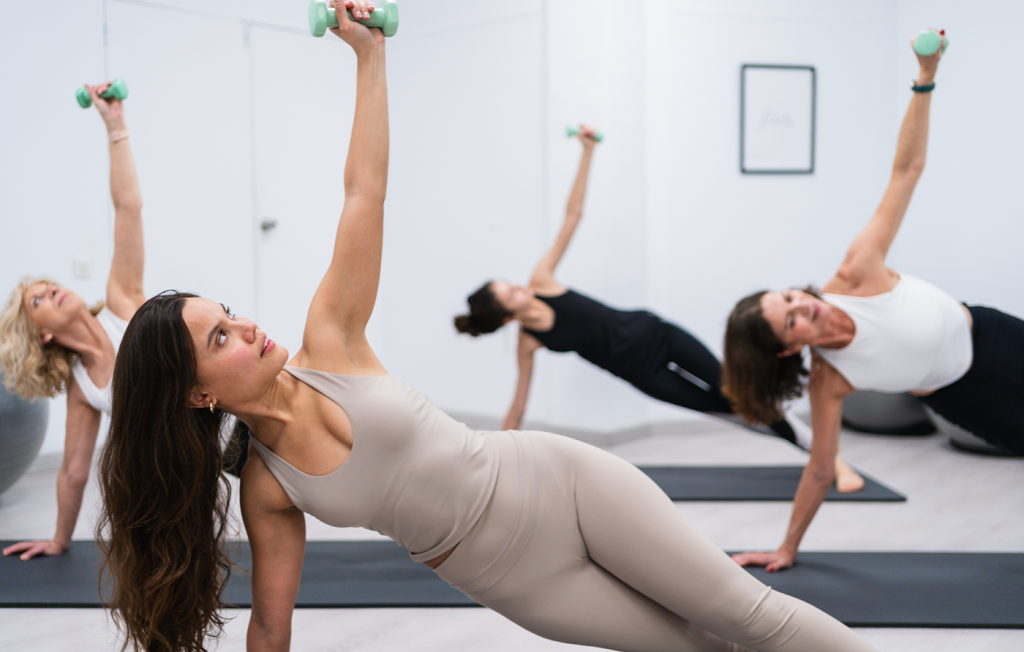
A key feature of Pilates for Core is the multidimensionality of the movements. The core is challenged in flexion, extension, rotation, and lateral flexion – often simultaneously.
In Pilates for Core Training, the anterior and posterior muscle chains must work together in a coordinated manner. Anti-rotation exercises activate the oblique abdominal muscles and the transversus abdominis under controlled tension against external forces.
These complex movement patterns prevent muscular imbalances and promote a resilient core definition. Because the movements are similar to everyday activities, the benefits are transferred to the body. Pilates for Core developed stability directly in real-world stress situations – such as lifting, turning, or balancing.
From optical tension to functional strength
Many training programs pursue core definition solely as an aesthetic goal. While high repetitions of isolated abdominal exercises can make a six-pack visible, the deep stabilizing muscles often remain underdeveloped.
Pilates for Core takes a different approach. Here, core definition arises as a result of holistic activation of all muscle layers. Visible form is not the goal, but rather the consequence of functional integration.
Pilates for Core transforms the core into a platform for true performance. The developed strength supports changes of direction, carrying movements, and dynamic weight shifts. Core definition and functional strength merge into a unified whole that has an impact far beyond the studio.
Mind-body connection in Pilates for Core
A key component of Pilates for Core is the conscious connection between breathing and muscle activation. Every movement is synchronized with breath rhythm and concentration.
This mindful training approach not only improves core definition but also neuromuscular control. The core remains stable and responsive even under stress or fatigue. It is precisely this adaptability that makes functional strength sustainable.
Pilates for Core thus develops not only muscle strength but also body awareness – a combination that ensures long-term stability.
Core stability in everyday life through Pilates for Core
The effects of Pilates for Core don't end on the mat. An upright sitting posture, controlled standing, or stable walking are practical applications of the core definition developed during the workout.
Those who regularly practice Pilates for Core automatically integrate stability into everyday movements. The core muscles work actively instead of relying on passive structures. This helps maintain functional strength in the long term.
A new understanding of core definition
Pilates for Core represents a modern core training approach that combines aesthetics and function. Core definition is not understood as an isolated muscle pattern, but rather as an expression of coordinated, resilient strength.
Through precise, controlled whole-body movements, Pilates for Core shapes a core that is both visibly defined and functionally efficient.
A core that not only looks good, but also works reliably.
A core that moves consciously, stably, and powerfully.