Free shipping in DE
  30 day returns
  Secure payment
  2 years warranty





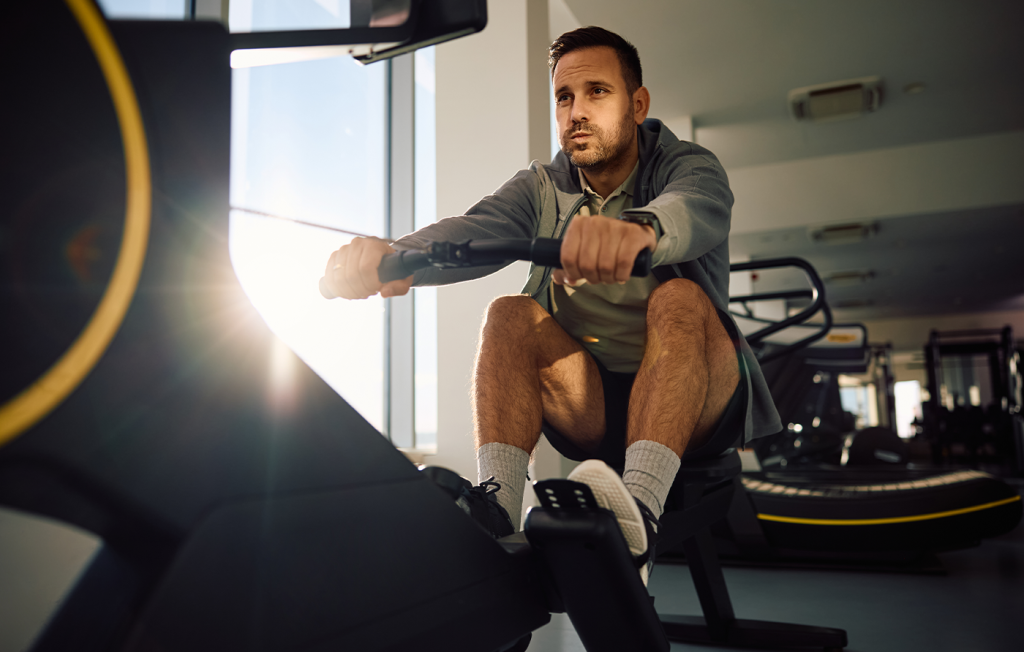
In the tranquil setting of a home gym, the rowing machine acts as a unique link between physical exertion and rhythmic movement. Unlike many fitness machines that focus on isolated movements, rowing requires the coordination of the entire body.
To truly benefit from this training, sheer exertion is not enough – understanding the mechanics of movement is crucial. Optimizing rowing technique for kinetic efficiency It doesn't simply mean rowing faster, but ensuring that every expended energy is converted into effective propulsion. Understanding biomechanical principles transforms training from a tiring activity into a sustainable and efficient practice.
The kinetic chain: force transmission from bottom to top
The basis of an efficient rowing stroke lies in the concept of the kinetic chain. This involves the coordinated activation of muscle groups – starting with the legs, through the torso, and up to the upper body.
When we talk about optimizing rowing technique for kinetic efficiency, the leg drive is key. Approximately 60% of the power should come from the initial push against the footrests. This primarily activates the quadriceps and glutes – the most powerful muscle groups in the body – without overworking the smaller arm muscles.
As the legs extend, the generated energy must be transferred through a stable torso. The core acts as a connecting element, preventing energy loss due to an unstable posture. This allows the force to be efficiently transferred into the pulling motion of the arms.
The importance of the force curve and smooth transitions
Modern rowing machines often offer a visual representation of power development – the so-called power curve. A smooth, bell-shaped curve is a clear indication of the Optimizing rowing technique for kinetic efficiency.
An uneven curve, on the other hand, indicates that the force is not applied consistently. This leads to unnecessary joint stress and reduces training efficiency.
The goal is a smooth build-up of force that reaches its peak in the middle of the pull phase and decreases in a controlled manner at the end.
Particular attention should be paid to the so-called "catch" phase – the moment the pull begins. Many beginners jerk the handle, which creates tension but yields little effective power. Instead, the movement should be initiated in a controlled manner and then accelerated smoothly.
Energy saving during the recovery phase
Efficiency is evident not only in power development but also in recovery. The recovery phase is a crucial component of... Optimizing rowing technique for kinetic efficiency.
A common mistake is returning to the starting position too quickly, which disrupts the rhythm. A ratio of 1:2 is recommended – the recovery phase should last twice as long as the pull phase.
During this phase, the muscles can briefly recover and be oxygenated. A relaxed grip and controlled movement help conserve energy and efficiently prepare the next move.
Breathing technique and cardiovascular efficiency
Movement and breathing are closely linked. For a constant energy supply, breathing should be synchronized with movement.
Optimizing rowing technique for kinetic efficiency includes:
Exhale during the pull phase
Inhalation during the retraction phase
This breathing technique stabilizes the body and ensures an efficient oxygen supply to the muscles.
Controlled breathing reduces premature fatigue and supports cardiovascular performance, making it possible to maintain a consistent workload over a longer period.
Mental component and technical precision
The Optimizing rowing technique for kinetic efficiency It is not only a physical but also a mental task. It requires concentration on details of movement such as grip, sitting position, and rhythm.
Every rowing stroke offers the opportunity to make small improvements – such as a more stable posture or more relaxed shoulders.
This conscious execution promotes body awareness, reduces the risk of injury and improves training quality in the long term.
Conclusion: Sustainable efficiency in training
Focusing on the mechanics of movement is key to effective training. Optimizing rowing technique for kinetic efficiency transforms the rowing machine into a powerful training tool.
Improved technology makes movements more efficient, natural, and effective for muscles and the cardiovascular system. This creates a sustainable training approach that leads to increased performance and health in the long term.