Free shipping in DE
  30 day returns
  Secure payment
  2 years warranty
Correctly setting up an ergometer – A comprehensive guide
In the world of home exercise equipment, the stationary bike is one of the most effective and versatile options. Whether you're looking to improve your cardio, burn calories, or increase your endurance, a stationary bike can be a great investment. But to get the most out of your workout, it's essential to set up your stationary bike correctly. This guide will walk you through the step-by-step process of setting up your stationary bike correctly to achieve maximum results.
1. The importance of correct ergometer setting
Before we delve into the details of ergometer adjustment, it's important to understand why proper adjustment is so crucial. An incorrectly adjusted ergometer can not only lead to inefficient workouts, but also injury and long-term health problems. By adjusting your ergometer correctly, you can ensure you get the full potential from your workout while preventing injury.
1.1. Seat height and position
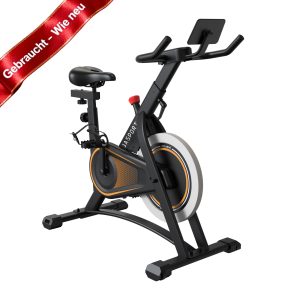
The seat height and position are crucial for an effective workout on the ergometer. The seat should be adjusted so that your legs are at a 90-degree angle when the pedal is in the lowest position. This ensures that you can use your legs effectively without risking overload or muscle fatigue.
1.1.1. Tips for correct seat height adjustment
- Stand next to the ergometer and make sure the seat is at hip height.
- Sit on the seat and make sure your leg is almost straight when the pedal is in the lowest position.
- Test the seat height by doing a few pedal revolutions. Your knee should be slightly bent.
1.2. Handlebar position and grip width
The correct handlebar position and grip width are just as important as the seat height. The handlebars should be in a position that allows you to have an upright and comfortable posture. The grip width should be chosen so that your arms can comfortably reach forward without you having to overstretch.
1.2.1. Tips for correct adjustment of the handlebar position and grip width
- Make sure the handlebars are at a height that allows you to ride with a straight back.
- The grip width should be chosen so that your arms are comfortably stretched without you having to pull your shoulders up.
- Experiment with different positions to find the ideal setting for you.
2. The correct setting of the resistance level
Resistance is another important aspect of ergometer setting. The right resistance level depends on your training goals and fitness level. Too low a resistance can lead to ineffective workouts, while too high a resistance can lead to strain and injury. It is important to set the resistance level so that you are challenged but still able to perform the workout with proper technique.
2.1. Tips for setting the resistance level correctly
- Start with a low resistance and gradually increase it until you reach a challenging but doable intensity.
- Make sure you maintain a consistent pedal rotation throughout your workout, regardless of the resistance level you choose.
- If you have difficulty handling the resistance, you should reduce it to avoid injury.
3. The importance of warm-ups and cool-downs
Aside from setting up your ergometer correctly, it is also important to do appropriate warm-up and cool-down exercises before and after your workout. Warming up helps prepare your muscles for the upcoming workout and prevents injury. Cooling down helps your muscles recover and prevents muscle soreness.
3.1. Warm-up exercises for ergometer training
- Do light cardio exercises such as jogging or jumping rope for 5-10 minutes to increase your heart rate.
- Stretch your legs, arms and back to warm up your muscles and improve flexibility.
- Do a few practice laps on the ergometer at a low intensity to prepare your muscles for the workout.
3.2. Cool-down routine after ergometer training
- Ride the ergometer for 5-10 minutes at low resistance to slowly lower your heart rate.
- Stretch your muscles to maintain flexibility and prevent muscle soreness.
- Take time to relax and recover after completing your workout.
Conclusion
The correct setting of your ergometer is crucial for effective and safe training sessions. By correctly adjusting the seat height, handlebar position, grip width and resistance level, you can get maximum results from your training and prevent injuries. Don't forget to do appropriate warm-up and cool-down exercises before and after training to optimally activate and regenerate your muscles. A well-adjusted ergometer will not only help you achieve your fitness goals, but will also give you long-term enjoyment from home training.